






Close Look - Seek out real returns as inflation climbs
What are real returns?
At times like these, when the rate of inflation jumps sharply upwards, it pays to keep a close eye on real investment returns. What exactly is a real return? Simply put, it is any percentage gain on an investment minus the inflation rate. The real return factors in the extent to which inflation erodes the value of investment gains over time. This calculation matters, as it allows an investor to judge the level of gain that has actually been made, sometimes described as made ‘in real terms’.
Why do real returns matter?
The chart below shows, as an example, that there is a striking difference between the nominal (i.e. the stated percentage gain) and real returns of US equities over a given 10 year period. After recognising that returns can be real and not just nominal, an investor can focus on seeking out assets with an enhanced real return. These assets will protect the future growth of their portfolio.
Performance of US equities in nominal and real terms
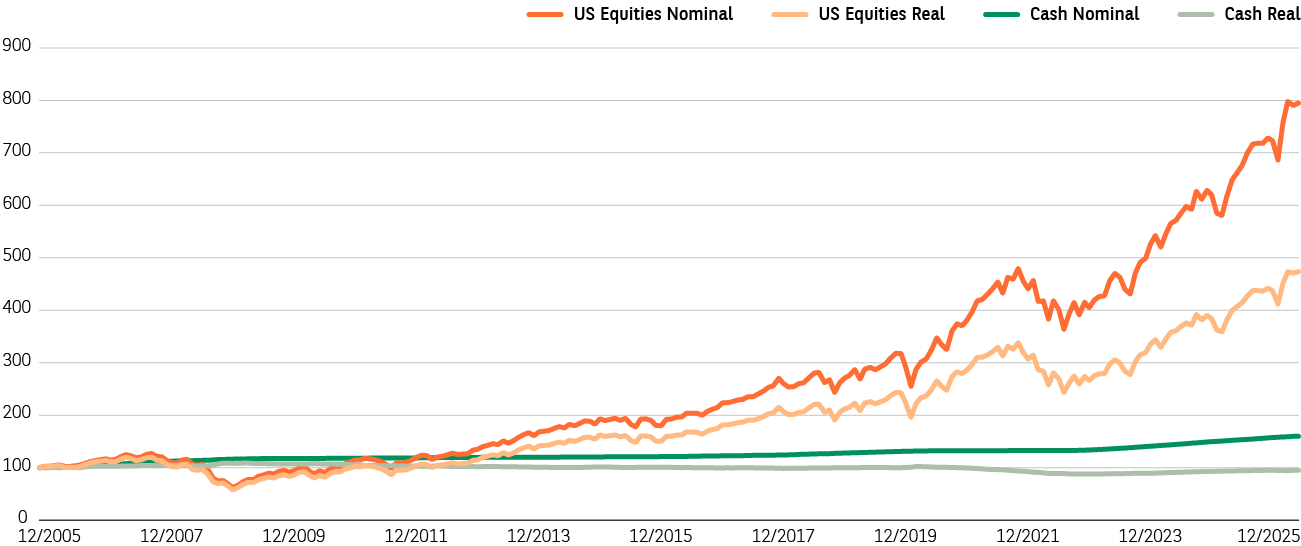
Source: Bloomberg, BNP Paribas Asset Management. Data from 1 January 2016 to 31 December 2025, US dollars. Rebased to 100 as at graph start date. Past performance does not predict future returns.
What is the current situation?
The Middle East conflict triggered a highly volatile period for crude oil and other petrochemical prices. This created economic shockwaves, as oil is a significant component of expenditure, forcing inflation expectations higher. This in turn nudged up forecasts for central bank interest rates. Indeed, both the European Central Bank and the Bank of Japan have moved their policy rates higher.
How did the markets respond?
Bond markets showed their typical response to rising inflation forecasts. Bond yields rose, meaning the price of the bonds fell. Equity markets remained strong in the second quarter, buoyed by their enthusiasm for the AI investment supercycle, although the fear of higher interest rates has nonetheless impacted some equity market valuations.
Where does inflation go from here?
Future developments in the Middle East situation are hard to predict, which creates uncertainty around inflation forecasts. Central banks will closely monitor economic data, looking to respond to inflation flare-ups as they feel appropriate. It is worth noting that, while recent US inflation prints have far exceeded target levels, the US Federal Reserve remains reluctant to pull the monetary policy levers, in case current inflationary challenges prove to be temporary.
Our view
The clear message is that, with or without the oil shock, inflation should remain at the forefront of an investor’s mind, as rising rates of inflation will eat away at the real value of returns on an investment. In our view, investors should always be looking to protect their portfolios by investing in a diversified range of assets, which have the potential for positive real returns.