





Close Look - Why diversification is your friend in a volatile market
What is the situation?
The conflict in Iran has caused major uncertainty for investors. One of the main consequences has been volatility in the oil price, which has had ramifications for many economies, businesses and consumers. As a result, we’ve seen stocks sell off as investors considered the potential impact of higher inflation on companies’ profit margins. In addition, bonds have struggled to provide the necessary diversification against the risks from the equity market.
Energy-driven inflation risk
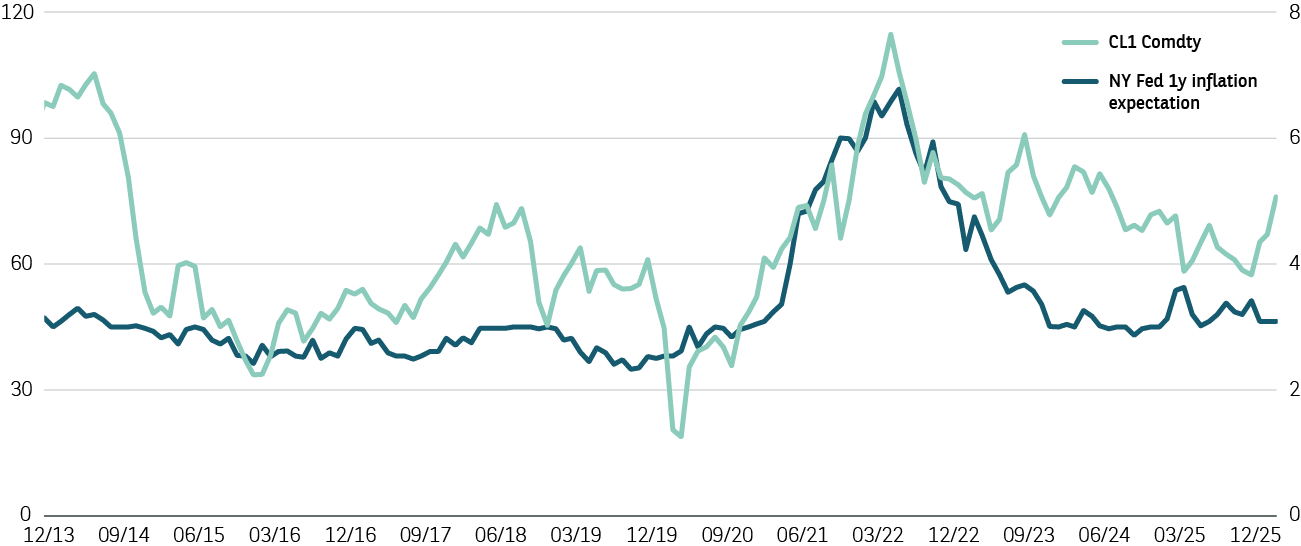
Sources: Bloomberg, BNP Paribas Asset Management, US Fed, 28 February 2026
What are the potential outcomes?
This leaves investors with a dilemma on how to position themselves in a volatile market. While the news has been particularly noisy, we cannot predict what will happen next in this environment or how long the uncertainty will last.
At the moment, we believe there are two main scenarios. We could see a rapid de-escalation in the hostilities, which should see markets revert to the trend we had before the conflict. In this environment, there is likely to be a continued broadening of earnings growth, with sectors and regions outside of tech and the US growing earnings.
The alternative is a prolonged conflict, which could lead to stagflation. This is an environment of high inflation and low growth, where we believe US assets are well positioned due to their low reliance on imported oil.
Why active diversification is important
So, where does this leave investors who want to position their portfolios amid spikes in asset prices? Diversification is not a new concept when talking about protecting your investment against big market swings or in periods of uncertainty. However, we believe diversification means different things depending on the regime you’re operating in.
In our view, both the scenarios highlighted above require active diversification strategies. If we do return to a broadening of the earnings theme, we believe there will be a need to diversify away from the ‘Mag 7’ and the US. Before the conflict, we found opportunities in emerging markets and Europe.
Equally, in a world of stagflation, we believe investors would need to be more precise in their asset selection to find positive returns. In addition, a focus on high-quality stocks and bonds will likely be increasingly important.
In both scenarios, active management could benefit investors, through fund selection for the various environments and by having flexible allocations to different asset strategies. Active managers can also use cash reserves to help smooth volatility, or deploy cash as attractive opportunities arise after a selloff.
Our view
The conflict has added significant uncertainty due to its direct impact on the global energy market. Regional earnings and inflation trends have become highly unpredictable.
We’ve decided to reduce our equity exposure in emerging markets, Europe and Japan back to neutral, aligning them with our exposure to the US. We maintain a preference for gold over long-term bonds. We believe our position emphasises flexibility, patience and diversification.