






Close Look - Emerging market equities lead the way
What is the situation?
Emerging market (EM) equities have made a strong start to the year, outperforming the US and other world indices. For example, the MSCI EM index jumped almost 9% in January, while the S&P 500 rose only 1.4%. This follows hot on the heels of a 31% rise for the MSCI EM index last year, the best performance since 2017. Over the month of January 2026, the total value of the MSCI EM index soared by more than $1 trillion to $28 trillion, having started 2025 at $21 trillion.
Emerging market stocks have outperformed US and world indices
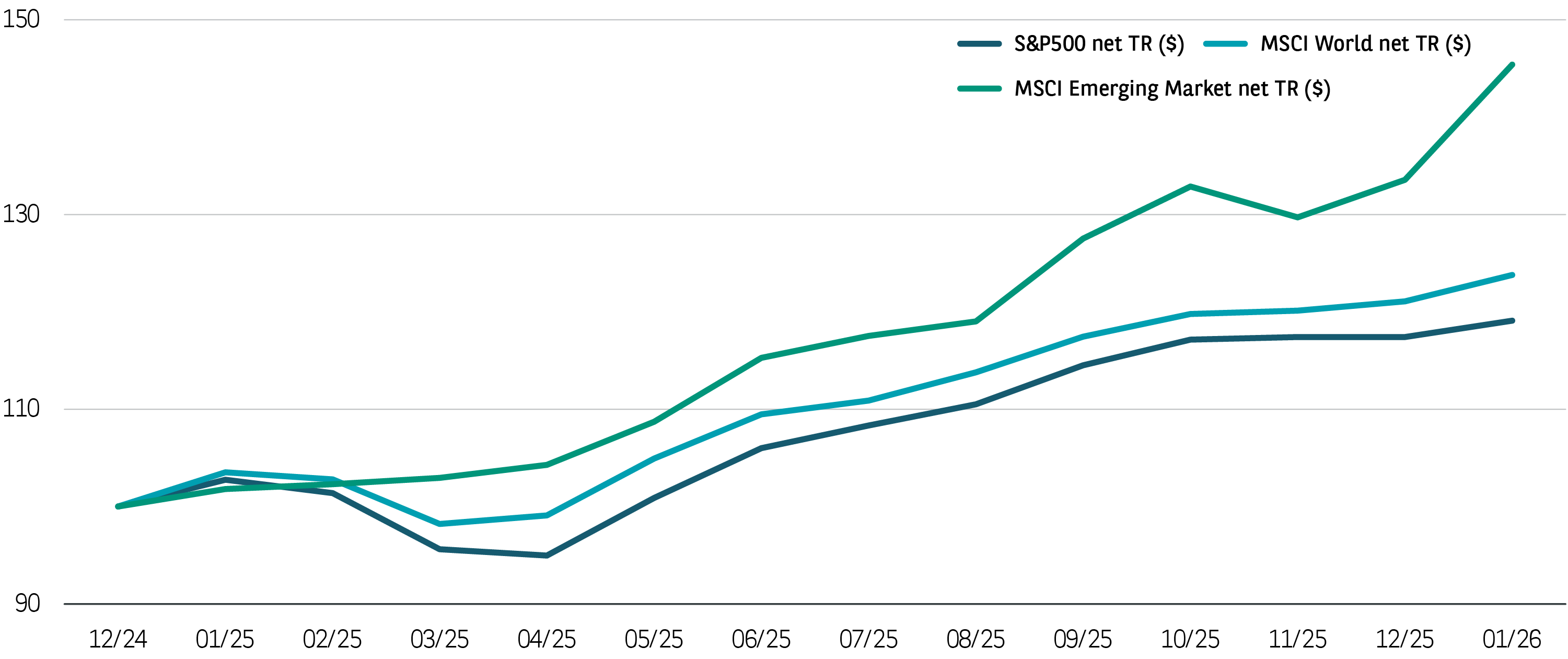
Sources: Bloomberg 19.02.2026, Index (31.12.2024 = 100), net total return in US$
What is the background?
Two main reasons can be identified for EM equity outperformance- based on relative currency movements and the constituent companies of the EM equity indices themselves. Let’s look at currencies first. With several US Federal Reserve rate cuts expected this year, the US dollar is languishing at a four year low. This period of weakness for the currency follows a decade of dollar strength, driven latterly by the cycle of higher US interest rates from 2022 until 2025.
Meanwhile, within the emerging markets, central banks have pushed domestic interest rates above their rate of inflation in recent years, aiming to make their own currencies more appealing and to stem years of capital outflow into the dollar. This capital can instead be invested locally, boosting EM equity and bond markets.
Secondly, let’s consider how the constituents of the MSCI EM index provide insight into its strong performance. A large part of the index is made up by Taiwanese and Korean chipmaker stocks. With AI ‘hyperscalers’, such as Amazon and Microsoft planning around $660 billion in capex this year, they stand to reap huge benefits.
Added to Asian tech, the massive rally in the price of gold and other precious metals over the last year has boosted earnings forecasts within the commodity rich index constituents, with South Africa and Latin America as prime examples.
Why does this matter?
Global equity market indices had become heavily concentrated in US and tech equities. Developments in the prospects for AI, such as this vast capex spending and the launch of new AI work tools have brought a bout of volatility to US equity markets. Weakness in the software sector has been particularly marked.
Meanwhile the expected broadening of earnings growth away from US tech, has led markets to ‘follow the money’. This has benefited value sectors across equity markets, with emerging market equities particularly in demand. Investors are increasingly confident in the benefits of higher earnings growth and lower valuation levels among international (ex-US), quality and value stocks.
Diversification in action
Diversification within equity markets and regions, a wider blending of sector and regional exposure, should allow investors to benefit both from this broadening of earnings, as well as from the “challenged US dominance” theme. This benefit is evident among EM equity markets, where earnings momentum is accelerating, driven by the tech and materials sectors.
Our view
The current environment could bring higher levels of equity volatility than observed last summer. Investors would be wise to expect wider price fluctuations.
We believe that diversifying regional, style and sector equity exposures away from US and growth stocks, or highly valued companies with strong future profit forecasts, is one way to soften the impact of these price movements. We prefer to gain equity exposure through European, Emerging market and Japanese stocks.
Furthermore, an allocation to gold might offer better diversification than a bond allocation, as regards geopolitical, budget deficit and inflation risks, increasing a portfolio’s resilience to shocks.
2026 could offer attractive opportunities and diversification should play a particularly important role in an investment portfolio.